Profile
Seventeen years.
One consistent
thread.
I've spent my career trying to understand how things actually work: not how they're supposed to. What follows is the story of how that instinct was built.
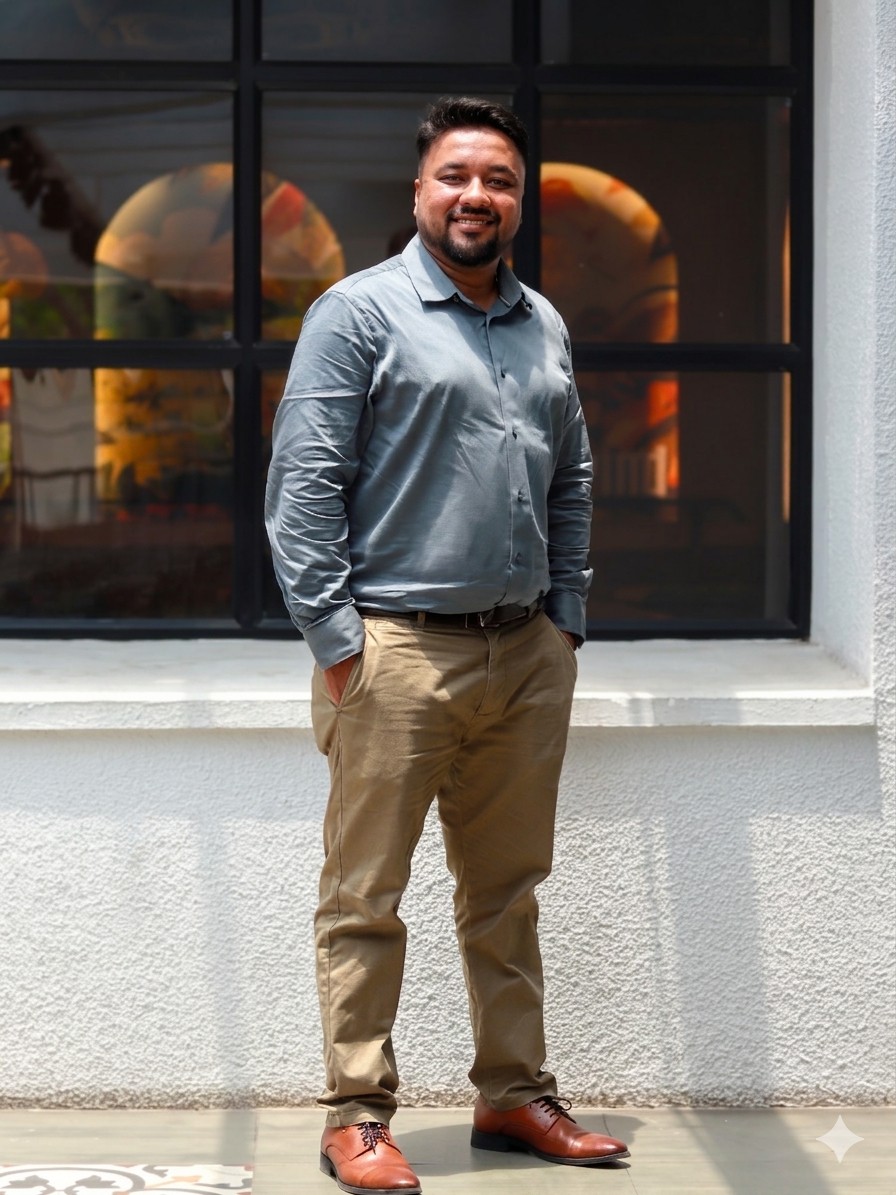
I grew up in Bhopal in a middle class household where English wasn't spoken much. I struggled with school for a while — the instructions didn't make sense without the first principles behind them. That gap frustrated me more than it defeated me.
Physics arrived in Class 9 and something opened. The patterns were unmissable. People were trying to explain the world and having fun with ideas. By Class 10 I had caught up with English too — well enough to earn 96 points and a national merit certificate from the board.
Three years of rigorous preparation for competitive exams followed. JEE didn't happen — apparently I wasn't that sharp. NIT Bhopal did. And college became something else entirely: public speaking, organising events, student elections, group dynamics. I used to apply physics principles to people problems. Others found it amusing. I couldn't help it.
The instinct to understand systems — not just operate within them — was forming. I didn't have a word for it yet.
I started at Areva T&D in Chennai in 2009. The company became Alstom, then GE. Three names, one desk, one relentless education in how large organisations actually function.
I moved into client-facing roles early. People had become important to how I made sense of things. Meeting new ones meant shared experiences and a deeper map of how systems operate under pressure.
Over time, my work moved closer to where revenue actually flows. I found myself building tools that made that movement more efficient:
Two promotions in two years. The products I worked on were not abstractions — these were India's power infrastructure projects. Large government utilities. Multi-crore negotiations. Contracts that took years to close.
At Silvan Labs it became clear quickly: without GE behind me, I had to become the reason someone opened the door. There was no brand to borrow credibility from. That was the most clarifying professional discomfort I'd experienced.
The product was in an emerging category — IoT, early-stage enterprise tech. The feedback loop was tight and personal. I went deep into the product ecosystem not because I was asked to, but because selling something I didn't fully understand felt dishonest.
Silvan is where some of the most durable lessons formed:
Within a year I was heading enterprise business. Building relationships with Honeywell, IBM, Wipro, Landmark Group. C-level rooms stopped feeling foreign.
Tata Teleservices followed — a brief and honest mismatch. But I got something unexpected from it: watching a skilled manager direct fifteen high-ability salespeople through brutal competition. You learn from the places that don't fit too.
Then came the leap. A few friends, a conviction, and an AR company — Allumer Technologies.
My role sat at the intersection of product and market. I shaped the product experience from a user and business lens, defined how the company presented itself externally, handled legal, branding, investor conversations, and early business development. Everything that wasn't the core technology — that was mine to figure out.
We built an MVP quickly. Got real traction with a large consumer-facing business. Won competitions, including STPI Chunauti. Investment firms took meetings. Showed genuine interest.
They were right. AR didn't take off the way we'd imagined. After three years of building, pitching, and trying to convince the world we were the right bet — we switched off the lights.
Most founders carry their first failure quietly. I carry mine as the most clarifying experience of my professional life. I had stood in front of investors with something built from nothing, read a market wrong, and found my footing again. That is a different kind of knowing — one that no job title confers.
What Allumer gave me, in practical terms:
By the time Allumer ended, the world had quietly moved on. AI was everywhere. I was down and out, seriously questioning my decisions. After rebuilding the basics — resume included, thank you Canva — I got into Infilect.
What started as Partner Management in the Founder's office expanded into owning international accounts across the US, UK, Canada, and Indonesia. Renewals, partnerships, and high-stakes SaaS implementations. I was hungry and there was a lot on the table.
I worked with global CPG businesses — food, beverages, personal care — while building partnerships across North America, Europe, the Middle East, South America, and Southeast Asia. The post-COVID business world was different: shorter meetings, sharper requirements, real demand.
The SaaS ecosystem operated by entirely different rules than anything I'd encountered. Platforms built to scale. Deliverables that fed live, thriving systems rather than one-off processes. The precision required in holding multiple variables simultaneously — client needs, partner dynamics, delivery timelines, business strategy — sharpened something that had been building for years.
At Ai Palette I stepped deeper into AI within the F&B and CPG space. The problem was different — research through live data rather than operational market intelligence. But the underlying question was the same: how does AI actually create leverage inside a business, that has banks on traditions to scale innovation.
The company had just been acquired by GlobalData, and that transition was visible in everything — how decisions were made, how quickly things moved, how accountability was structured. I watched from the inside what happens when a founder-led startup meets the governance systems of a global acquirer.
I worked with clients across Southeast Asia, the Middle East and Africa, Europe, and North Africa. Globally distributed teams across very different business cultures. The product interface carried as much weight as the deliverable itself.
This phase deepened something that had been accumulating across every chapter before it: a precise sense of where AI creates real structural advantage across non-tech domains.
What's next
Nova Creatrix.
Why now.
I didn't plan to become an advisor. I became one because I kept seeing the same pattern: founder-led companies at an inflection point, with real capability and real ambition, but without someone who could read the whole system and help them make the right next move.
The work usually begins with understanding how the business actually operates today — not how it's described, but how decisions are made, where friction exists, and where leverage actually sits. From there, I help shape the next phase: go-to-market, AI implementation, new verticals, or the structural changes that make growth hold rather than fracture.
On AI specifically: I'm not an evangelist and not a doomsayer. I've watched technology cycles arrive and settle — computers, internet, mobile, cloud, now AI. Each one rewired efficiency without dissolving human capability. This one will too, for the organisations that approach it with clarity. The fundamentals of business haven't changed: unit economics, product reliability, trust. AI is a tool that accelerates toward those fundamentals — or away from them, if the intent isn't right.
That's what I'm here to help navigate.
Start a conversation
If the next move matters
but isn't obvious yet —
Engagements by direct enquiry. Every approach is answered personally.
Get in touch ← Back to the practice